If you've read our guide on early pregnancy signs, you already know that nipple changes, a rounding belly, and shifts in appetite can only get you so far — they're suggestive, not definitive, and they overlap heavily with a false pregnancy. Sooner or later, if you want an actual answer, you need one of four real diagnostic methods: abdominal palpation, a relaxin blood test, ultrasound, or X-ray.
The confusing part is that none of these four methods works at every stage, and none of them answers every question. A test that confirms pregnancy at day 25 won't tell you how many puppies to expect, and a test that gives you an exact puppy count won't work until well past the point most owners want an answer. This guide walks through each method individually — what it actually measures, when it becomes reliable, what it costs, and what it can't tell you — so you know exactly what to ask for and when to ask for it.
Why "Just Look at Her" Isn't a Method
It's worth saying clearly, since it comes up constantly: evaluating nipple size, weight gain, or general belly shape is not considered a reliable diagnostic method by veterinary standards. These changes can and do occur in false pregnancy, in normal diestrus, and in dogs who simply gained weight for unrelated reasons. If you want a real answer, you need one of the four methods below — there isn't a reliable at-home visual shortcut, however tempting it is to believe otherwise.
Method 1: Abdominal Palpation
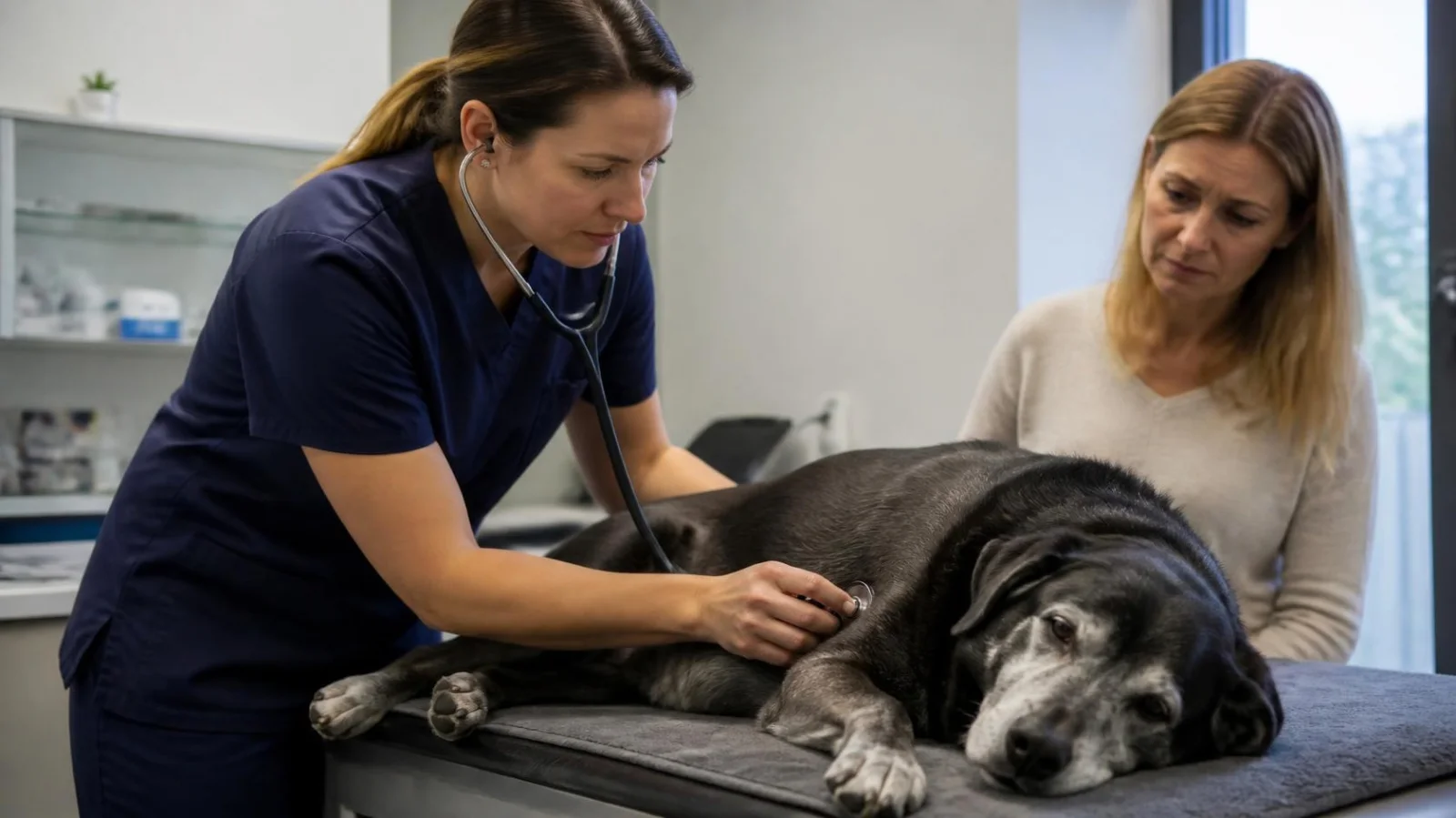
Palpation is exactly what it sounds like — a vet gently feels along your dog's abdomen with their hands to detect small, ovoid swellings along the uterine horns, which represent developing fetuses arranged like beads on a string.
When it works
Palpation has a genuinely narrow window of usefulness: roughly days 28 to 32 after breeding, sometimes stated as broadly as 21 to 30 days depending on the source. Before that window, the fetal swellings are too small and diffuse to reliably feel. After it, the uterus becomes more fluid-filled and the individual swellings blend together, making them much harder to distinguish by feel alone — so a vet who palpates at day 40 may find nothing distinct even though the dog is very much pregnant.
What it can and can't tell you
At best, an experienced vet can tell you "yes, I feel multiple swellings consistent with pregnancy." It is not considered reliable for determining an exact puppy count, and it cannot tell you anything about whether the puppies are alive and developing normally (their viability). Its accuracy also depends heavily on the individual dog — a lean, relaxed, cooperative dog is much easier to palpate accurately than an anxious, overweight, or tense one, and results genuinely vary by the experience of the person performing it.
What to expect at the visit
This is typically a quick, low-stress exam performed while your dog stands or lies on the exam table, without sedation, and often takes only a minute or two. Many vets will pair it with a general wellness check during the same visit rather than scheduling it as a standalone appointment.
Bottom line
Useful as a quick, low-cost early check if the timing lines up, but not something to rely on as your only source of confirmation — especially if the timing is uncertain or the first attempt comes back negative.
Method 2: Relaxin Blood Test
This is arguably the most underrated method, and it solves a specific problem the others don't: telling true pregnancy apart from false pregnancy with certainty.
How it works
Relaxin is a hormone produced specifically by the placenta once it forms — which means, unlike nearly every other pregnancy-adjacent sign, it is genuinely only present in a real pregnancy. A dog experiencing a false pregnancy can show nesting behavior, nipple changes, and even lactation, but her relaxin blood test will always come back negative. This makes it the definitive tiebreaker when the physical signs are ambiguous.
When it works
Relaxin can be detected in blood starting around day 20 to 22 post-breeding, but sensitivity is not yet complete that early — a negative result before day 28 doesn't fully rule out pregnancy, since the placenta may not yet be producing enough relaxin to register. By day 29, sensitivity is reported to reach essentially 100%. Because of this early-testing risk, veterinary guidance is specific: a dog testing negative between days 22 and 27 should be retested about a week later before that negative result is treated as final. Roughly 80% of the time, two consecutive negative tests one week apart, starting in that 22–27 day window, do confirm the dog isn't pregnant.
What it can and can't tell you
It gives a clear pregnant/not-pregnant answer and reliably distinguishes real pregnancy from false pregnancy — but it cannot tell you how many puppies there are, and it doesn't assess fetal viability the way an ultrasound can.
In-clinic vs. at-home options
Most relaxin testing happens as an in-clinic blood draw with results available same-day or within a couple of days, depending on whether your vet runs it in-house or sends it to an outside lab. At-home versions have also become available in recent years — the BellyLabs Canine Pregnancy Test is one example, using a small blood-drop sample read at home in 10–15 minutes, with manufacturer-reported accuracy around 96% from about day 28 onward. We cover this option in more detail in our early pregnancy signs guide, but the core advice is the same either way: a positive result is good news to bring to your vet, not a substitute for a full checkup.
This section includes an affiliate link — if you purchase through it, ItsWagging may earn a small commission at no extra cost to you.
Bottom line
The best single method if your main question is "pregnant or false pregnancy" rather than "how many puppies." Just respect the day-28 rule and don't over-interpret an early negative.
Method 3: Ultrasound
If you only get one diagnostic test during pregnancy, most vets would point you toward this one. It's widely considered the gold standard for early confirmation because it does something none of the other methods can: it lets you actually see the puppies, including whether their hearts are beating.
When it works
Ultrasound can sometimes detect pregnancy as early as day 21, but the more commonly cited reliable window is days 25 to 30, with some sources extending usefulness through day 35. Earlier than that, the gestational sacs may simply be too small to visualize with confidence.
What it can and can't tell you
Beyond a simple yes/no, ultrasound can confirm fetal heartbeats — genuinely reassuring information that no other early method provides — and it's also useful for distinguishing pregnancy from pyometra, since both can cause similar abdominal changes early on. Where it falls short is puppy counting: a rough estimate is possible, but because puppies overlap and move within the uterus, ultrasound is considered far less accurate than a late-term X-ray for getting an exact number.
What to expect at the visit
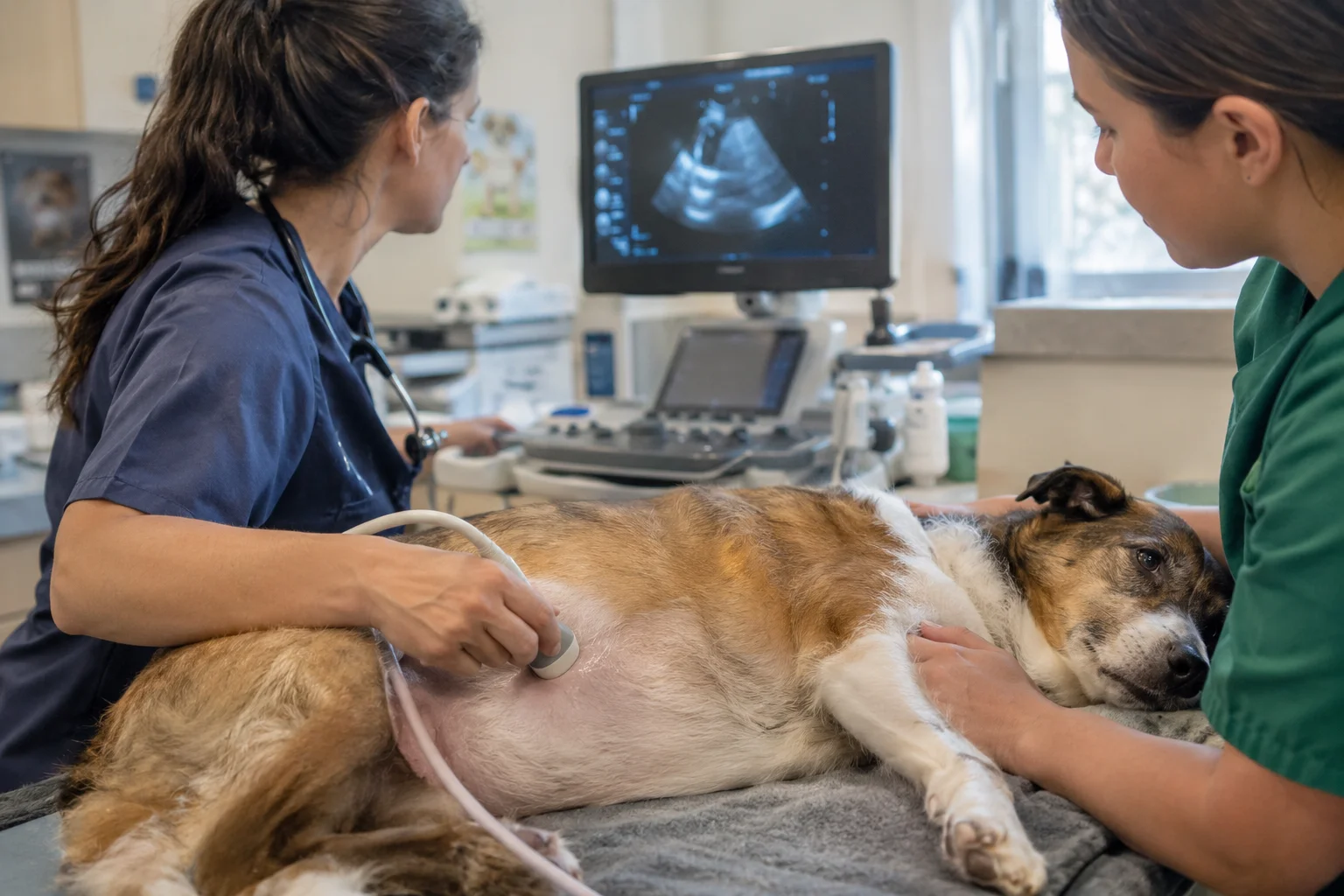
Your dog will typically lie on her back or side while a small area of her belly is shaved or dampened with gel, then a handheld probe is moved across the area while the vet watches a screen. It's non-invasive, doesn't use radiation, and most dogs tolerate it well without sedation. Appointments usually run 15 to 30 minutes.
What it costs
Cost varies significantly by region and by whether you're seeing a general practice vet or a specialized reproductive clinic. A pregnancy-check ultrasound through a general vet is often bundled into a routine visit fee, while dedicated reproductive ultrasounds at referral clinics can run considerably more — some clinics quote figures well into the hundreds of dollars. It's worth calling ahead and asking for a specific quote rather than assuming a number, since the range genuinely is wide.
Bottom line
The single most informative early test available, and the one most vets will recommend as the primary confirmation method if you're only doing one.
Method 4: X-Ray (Radiograph)
This is the method to reach for when your question shifts from "is she pregnant" to "how many puppies should I be expecting at delivery."
When it works
X-rays are essentially useless for early confirmation, and this is worth understanding rather than just accepting: puppy skeletons don't begin to mineralize (become dense enough to show up clearly on an X-ray) until around day 42 to 45 of gestation. Vets typically wait until day 45 at the earliest, with day 55 to 60 often cited as the ideal window for the most accurate final count, since it's close enough to delivery that all puppies should be fully calcified and visible.
What it can and can't tell you
This is the most accurate method available for counting puppies — reported accuracy in the 80–95% range — which matters practically for knowing when whelping is complete (so you're not caught off guard by a puppy that never arrives) and for flagging a larger-than-average litter that might need extra monitoring. It's not, however, a great tool for confirming pregnancy early, and it doesn't assess fetal viability the way a heartbeat check on ultrasound does.
What to expect at the visit
Your dog will typically need to fast for six to eight hours beforehand to reduce gas in the intestines that can obscure the image, then be briefly positioned on the X-ray table (usually without sedation, though very anxious dogs occasionally need light sedation). Radiation exposure at this stage of pregnancy, using standard veterinary equipment and proper technique, is considered safe for the puppies.
Bottom line
Save this one for the final couple of weeks before the due date, specifically to get a reliable puppy count — not as an early confirmation tool.
Comparing All Four Methods
| Method | Earliest reliable use | What it confirms | Puppy count? | Fetal viability? | True vs. false pregnancy? |
|---|---|---|---|---|---|
| Abdominal palpation | Day 28–32 | Presence of fetal swellings | No — unreliable | No | Not definitively |
| Relaxin blood test | Day 22–27 (retest if negative); reliable by day 29 | Presence of placental hormone | No | No | Yes — definitively |
| Ultrasound | Day 21–25 (reliable by 25–30) | Visible gestational sacs and heartbeats | Rough estimate only | Yes | Yes, indirectly |
| X-ray | Day 45+ (best at 55–60) | Fully calcified fetal skeletons | Yes — most accurate method | No | Not applicable this late |
Visualizing the Timeline
Because these four methods each become useful at a different point, it helps to see them laid out against the calendar rather than as a list. The bar for each method below starts at its earliest reliable day and runs through end of pregnancy (day 65), so you can see at a glance which tests overlap and which ones only make sense much later.
Bar length represents the window each method remains useful through the end of a typical 63–65 day pregnancy. Lighter shading marks a less certain or "retest recommended" period within that method's range.
Putting It Together: A Realistic Testing Schedule
Most vets don't ask you to pick just one method — they combine them at different points, since each answers a different question:
- Around day 25–30: Ultrasound (or a relaxin test if ultrasound isn't available) to answer "is she pregnant, and are the puppies developing." This is usually the first real appointment after a suspected mating.
- Around day 28–32, optionally: Palpation, often done as part of the same visit as the ultrasound rather than as a separate appointment.
- Around day 55–60: X-ray to get an accurate puppy count before whelping, so you know how many to expect and aren't left wondering if delivery is finished.
If your dog's early test comes back negative but you're still not certain, don't assume that's the final word — especially with a relaxin test taken before day 28, or a palpation attempt outside its narrow window. Ask your vet whether a retest or a different method makes sense given the timing.
When Results Don't Match What You Expected
Negative test, but she's showing signs. This is the classic false-pregnancy scenario — nesting, nipple changes, and even mild lactation can occur without any puppies involved. A relaxin test resolves this definitively, since it stays negative in false pregnancy regardless of how convincing the physical signs look.
Positive early test, but nothing shows up on a later ultrasound. Early pregnancy loss (resorption) can occur, particularly in the first few weeks, and isn't necessarily a sign of a broader health problem. If this happens, your vet is the right person to discuss what it means for future breeding, not something to try to interpret alone.
Palpation says no, but ultrasound says yes (or vice versa). Trust the more specific test. Palpation has a narrower reliable window and depends more on the individual dog and examiner, so a disagreement between the two generally favors the ultrasound result.
What If I Don't Know the Exact Mating Date?
This is more common than you'd think, especially with an accidental mating, a multi-day heat where mating happened more than once, or a dog who spent time with an intact male without direct supervision the whole time. All of the day-ranges above assume you know roughly when breeding occurred, so an uncertain date makes timing trickier, not impossible.
A few ways vets work around this:
- Use the widest reasonable window. If mating could have happened anywhere across a 4-5 day stretch, treat your testing dates as a range rather than a single day — test toward the later end of your estimated window rather than the earliest, since a too-early test is more likely to produce an unreliable result than a slightly late one.
- Progesterone testing during heat, if you catch it in time. If you suspect she's still in heat or was very recently, a vet can run progesterone tests to pinpoint ovulation directly rather than relying on when you happened to see mating occur. This is more relevant for planned breeding than after-the-fact confirmation, but it's worth knowing this option exists if you're trying to nail down timing early.
- Let ultrasound measurements estimate gestational age. Once a pregnancy is confirmed, measuring the size of the gestational sacs or puppies on ultrasound can give your vet a reasonable estimate of how far along she actually is, which helps correct for an uncertain mating date going forward.
- Don't over-trust a single negative result if timing is uncertain. If there's real ambiguity about when mating happened, a negative test at what you assumed was "day 28" might actually have landed at day 20 by the real timeline. When the date is fuzzy, plan on a follow-up test a week or two later rather than treating one negative as conclusive.
Do I Need a Reproductive Specialist, or Will My Regular Vet Do?
For most routine pregnancy confirmations, a general practice veterinarian is entirely sufficient — basic ultrasound confirmation, relaxin testing, and standard palpation are all things most small-animal vets perform regularly. A few situations are where a referral to a veterinary reproduction specialist genuinely makes a difference:
- Breeds prone to difficult labor (brachycephalic breeds like Bulldogs and French Bulldogs, in particular) where planning ahead for a possible C-section matters
- A dog with a history of pregnancy loss or difficulty conceiving
- Wanting precise ovulation timing via progesterone testing for planned breeding, which some general practices don't offer in-house
- An unusually large or unusually small litter suspected, where more detailed monitoring is useful
If your situation is a straightforward "did this accidental mating result in pregnancy" question, there's rarely a need to seek out a specialist — your regular vet's office is the right first call.
What This Actually Costs
Cost is one of the most search-for-but-rarely-answered parts of this topic, largely because it genuinely varies a lot by region, by clinic type, and by which combination of tests your vet recommends. That said, here's a general sense of how the costs tend to break down:
| Method | Typical cost factors | General price pattern |
|---|---|---|
| Abdominal palpation | Usually bundled into a standard exam fee | Often little to no added cost beyond the office visit |
| Relaxin blood test | In-house rapid test vs. sent to outside lab; retest fees if done twice | Generally a moderate add-on to an office visit; less than ultrasound |
| Ultrasound | General practice vs. specialized reproductive clinic; equipment quality; region | Can range from a modest add-on at a general practice to several hundred dollars at a dedicated reproduction referral clinic |
| X-ray | Number of views taken; whether sedation is needed; region | Comparable to or somewhat higher than a standard ultrasound at the same clinic |
Because the range is genuinely wide, the most useful thing you can do is call your vet's office ahead of time and ask for a specific quote for what they're recommending, rather than budgeting off an average found online.
Does Pet Insurance Help With Any of This?
It depends entirely on your policy and, in most cases, on timing. Most standard pet insurance policies are designed to cover unexpected illness and injury, and many explicitly exclude "wellness" or elective reproductive costs — which is often how routine pregnancy confirmation gets classified. Coverage is more likely if a complication arises (a difficult labor requiring a C-section, for example) than for the initial confirmation visit itself. If you already carry a policy through a provider like Trupanion or Lemonade, it's worth a quick call to ask specifically whether pregnancy-related veterinary visits are covered under your plan before assuming either way, since policy language on this varies more than owners expect. If you don't currently have coverage and you're planning to breed intentionally going forward, this is worth researching before the next heat cycle rather than after an unexpected complication.
Preparing for the Appointment
A little preparation makes these visits go more smoothly and gives your vet better information to work with:
- Write down the suspected mating date(s) as precisely as you can, including a range if you're not certain — this single piece of information shapes which test your vet recommends and when.
- Mention any signs you've already noticed (nipple changes, appetite shifts, behavior changes) and when they started, even if they seem minor.
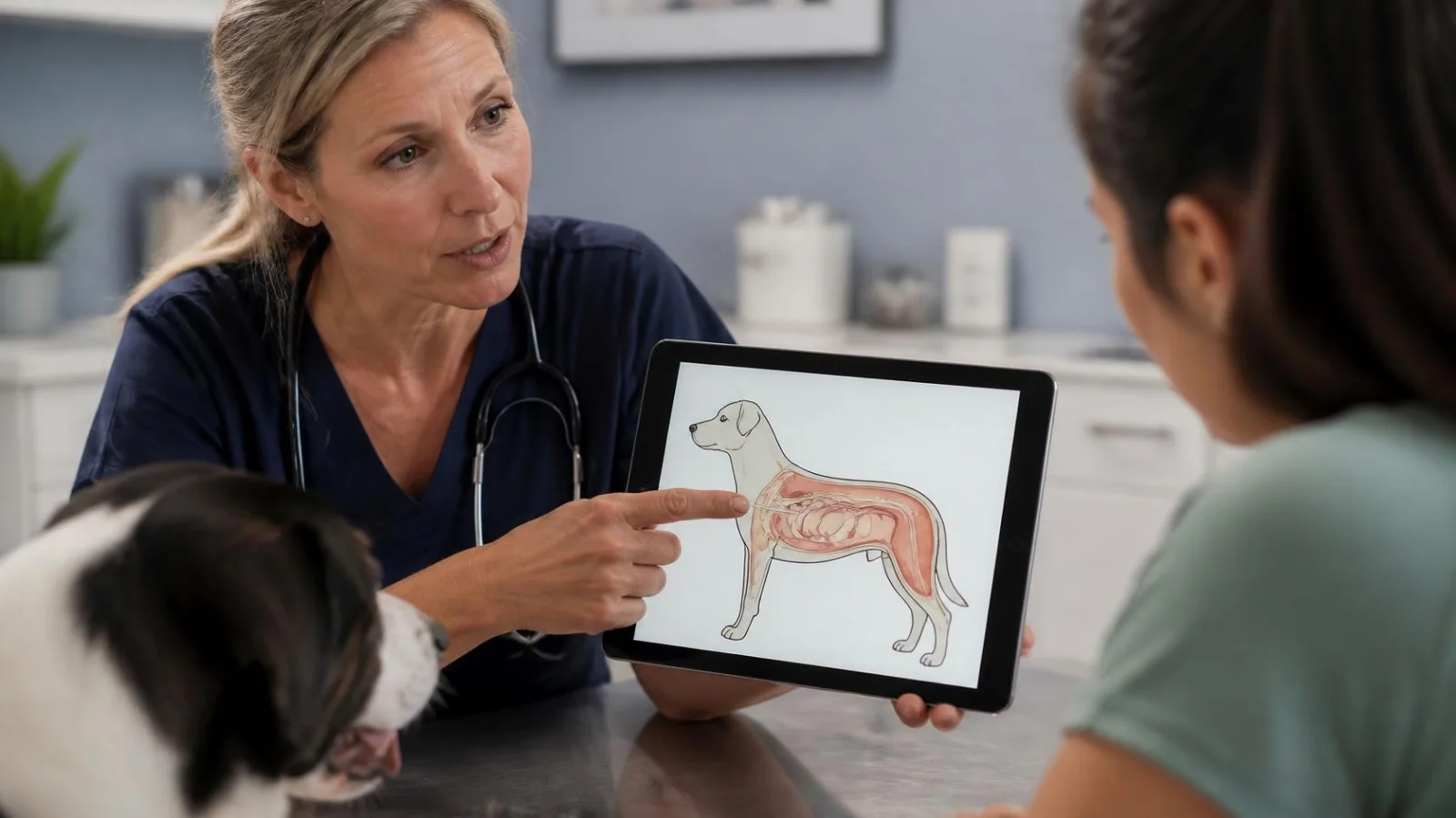
- Ask which test they recommend and why — given everything above, a good answer should reference the timing since mating, not just "let's do an ultrasound" by default.
- Follow fasting instructions exactly if an X-ray is planned, since food in the intestines can obscure the puppies on the image and mean a repeat visit.
- Keep her calm and comfortable beforehand — a stressed, tense dog is measurably harder to palpate accurately and can make ultrasound positioning more difficult too.
Explore This Guide
- Is My Dog Pregnant? Early Signs & How to Tell — the signs that bring most owners here in the first place
- How Long Are Dogs Pregnant? — what happens week by week once you have confirmation
- When Can a Female Dog Get Pregnant? — for understanding the mating timeline behind your test dates
- Pyometra in Dogs — a condition ultrasound is also used to rule out