The surgery itself is usually the easy part — it's the two weeks afterward that actually determine whether your dog heals cleanly or ends up back at the clinic with a reopened incision. The visible skin heals fast, often looking nearly normal within a week, but the deeper layers of the abdominal wall take the full 10 to 14 days to regain real strength. That gap between "looks fine" and "is actually fine" is where most spay complications happen, and it's exactly what this guide is built around — a full day-by-day map, what genuinely normal healing looks like versus what warrants a call, and the practical setup that makes the whole two weeks less stressful for both of you.
The Recovery Timeline, Day by Day
| Day | What's happening | What to do |
|---|---|---|
| Day 0 (surgery day) | Groggy from anesthesia, possibly wobbly or disoriented; incision is fresh, may look slightly red or bruised | Offer small sips of water; a small bland meal only if she seems alert and interested; quiet, warm space to rest; cone or recovery suit on immediately |
| Day 1 | Still tired but noticeably more alert than surgery day; some soreness moving around; mild swelling at the incision is normal | Small, easily digestible meals; short leashed potty breaks only; pain medication as prescribed; check incision once |
| Days 2–3 | Energy improving; appetite typically back to normal; incision may show mild redness or a small firm area underneath (often a normal seroma, not automatically a problem) | Continue strict activity restriction even though she may seem back to herself; this is when owners most often relax the rules too early |
| Days 4–6 | Often looking and acting completely normal; this is the highest-risk stretch for owners underestimating how much healing is still happening internally | Hold the line on activity restriction; no off-leash time, no stairs if avoidable, no jumping on furniture |
| Days 7–9 | Incision should look well-healed on the surface; skin edges sealed | Continue leash-only outings; VCA notes many dogs can begin a gradual, vet-guided return to normal activity around this point, but "gradual" is the operative word |
| Days 10–14 | Follow-up vet visit for suture/staple removal if needed, and a final check of the incision | Get explicit clearance from your vet before resuming full activity — don't assume day 14 is automatically "go" |
Visualizing Recovery Phases
It helps to see how the visible healing (what you can check yourself) compares with the internal healing (what actually determines when restrictions can lift) — they're on genuinely different timelines, which is the single most important thing to understand about this whole process.
The visible incision (top bar) can look completely healed by around day 7, while the deeper tissue layer (middle bar) and the activity restriction it requires (bottom bar) both need the full 14 days. This mismatch is exactly why "she looks fine" isn't a safe reason to lift restrictions early.
What a Normal Healing Incision Looks Like
| Timeframe | Normal appearance |
|---|---|
| Day 1–2 | Slightly red or pink, possibly mild bruising, skin edges close together |
| Day 2–3 | Mild swelling is common and often alarms owners unnecessarily — a small amount right at the incision line is typically normal |
| Day 3–7 | Swelling should be steadily decreasing, not increasing; redness fading; possibly some itchiness as it heals |
| Day 7–10 | Skin edges fully sealed, minimal redness, incision line may look slightly raised or firm to the touch |
| Day 10–14 | Should look essentially healed at the surface, ready for suture/staple removal if applicable |
A soft, small, fluid-filled lump near the incision — a seroma — is a fairly common finding, particularly in larger or more active dogs, and it usually resolves on its own with continued rest. It's still worth mentioning to your vet rather than diagnosing yourself, since a seroma can look similar to more serious complications to an untrained eye.
Warning Signs That Mean Call Your Vet
Most spay recoveries are uneventful, but these signs warrant a prompt call — not necessarily a panic, but not a "wait and see" either:
- Swelling that increases after day 3 rather than decreasing, especially if it's hot to the touch or clearly painful
- Discharge that's yellow, green, or foul-smelling, rather than a small amount of clear or slightly pink fluid
- The incision visibly opening, or tissue that looks like it's protruding — this is dehiscence, and it's an emergency, not a wait-for-the-morning situation
- Refusing food entirely beyond the first day, or vomiting that continues past the first 24 hours
- Fever, or lethargy that seems to worsen rather than steadily improve day over day
- Persistent licking or chewing at the incision despite the cone or suit — this is both a symptom to note and a direct cause of some of the complications above
The distinction between a seroma (soft fluid pocket, usually benign) and dehiscence (the incision actually separating, a genuine emergency) is exactly the kind of thing that's hard to judge confidently from a photo or a general description — if you're unsure which one you're looking at, that uncertainty itself is a good reason to call rather than guess.
Managing the Cone (Or Skipping It)
Licking is the single most common cause of incision complications, which is why some form of barrier for the full 10-14 days isn't optional, however much your dog protests. You have real options beyond the classic rigid plastic cone:
- The traditional plastic e-collar (like a Comfy Cone) is effective and widely used, though many dogs find it awkward for eating, drinking, and navigating doorways at first.
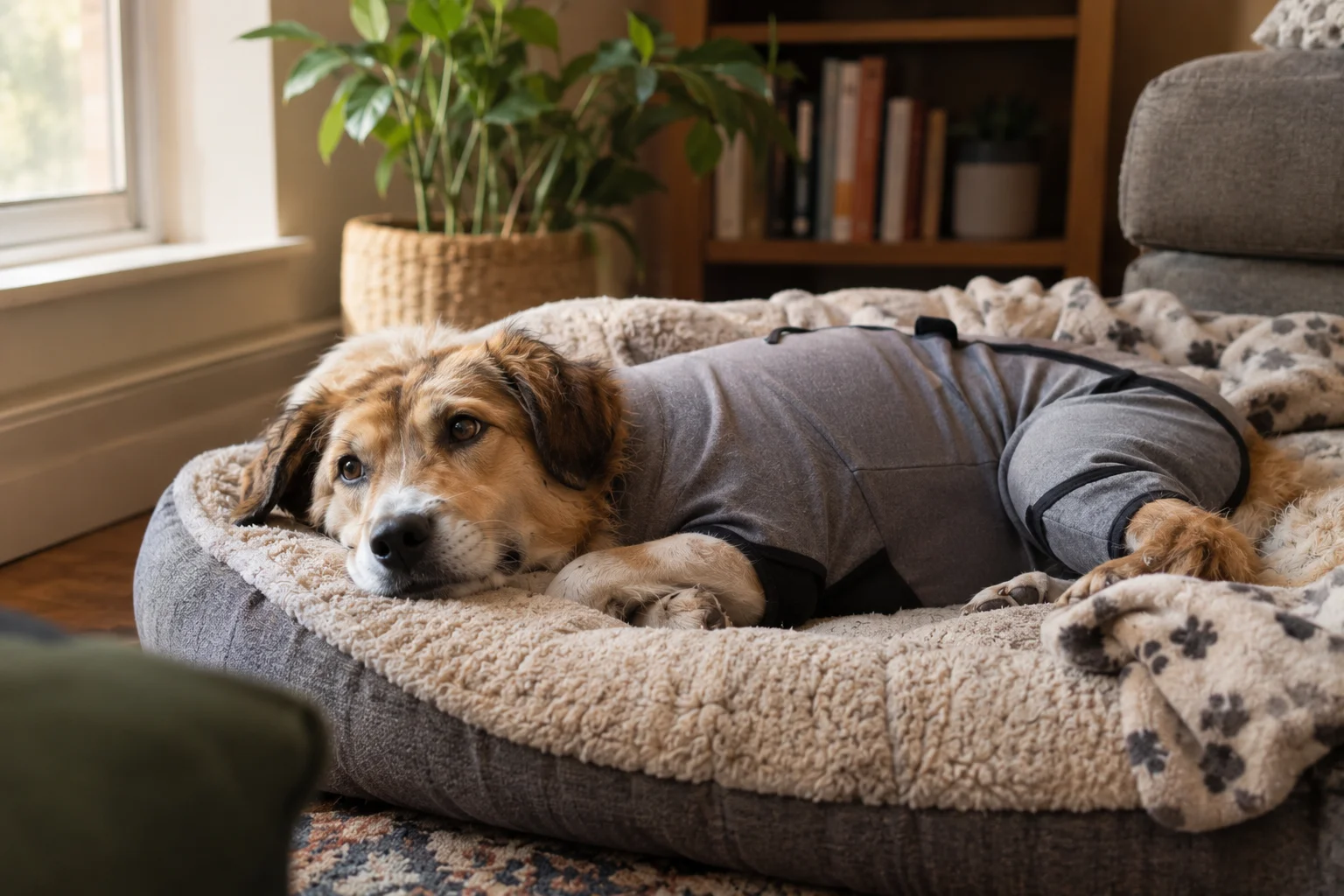
- A soft recovery suit — a snug, breathable full-body garment that covers the incision directly — has become a popular alternative precisely because it lets a dog move, eat, and sleep more naturally while still physically blocking access to the wound. The Suitical Recovery Suit is one widely used option, with a rear fastening design that can be pulled back for potty breaks without removing the whole suit, and a partially visible inner panel that lets you check for any fluid or discharge without fully undressing the incision.
- Inflatable donut-style collars are a middle ground some dogs tolerate better than rigid cones, though they offer less reliable protection for a dog who's especially determined.
This section includes an affiliate link — if you purchase through it, ItsWagging may earn a small commission at no extra cost to you.
Whichever option you choose, the rule is the same: it comes off only under direct supervision, never left off "just for a few minutes" while you're in another room — that's precisely the window in which most licking-related complications happen.
Activity Restriction: Why It's Non-Negotiable
Every jump, run, or set of stairs places direct mechanical tension on the abdominal wall while it's still rebuilding strength underneath a surface that looks deceptively healed. The majority of serious complications — both seromas and the more concerning dehiscence — trace back to excessive activity during days 3 through 10, precisely the window when a dog typically feels back to normal but isn't structurally ready to act like it. This is genuinely the hardest part of the whole recovery for most owners, harder than the surgery itself, because it means actively restraining a dog who feels completely fine and doesn't understand why.
| Allowed | Not allowed (for the full 10–14 days) |
|---|---|
| Short, calm, leashed potty breaks | Off-leash time, even in a fenced yard |
| Gentle, quiet interaction at home | Running, jumping, or playing with other dogs |
| Being carried up/down stairs if small enough | Climbing stairs unassisted, if avoidable |
| Calm crate or pen rest between outings | Jumping on or off furniture |
| Slow, short leash walks once your vet approves (typically not in the first several days) | Any unsupervised free-roaming time in the house |
A crate, playpen, or a single small confined room tends to work better than simply "keeping an eye on her" in an open house, since sudden bursts of energy — jumping at the door when someone arrives, chasing a household cat, spinning excitedly at feeding time — happen fast and are hard to intercept in an open space, even with the best intentions.
Feeding and Hydration During Recovery
Appetite typically follows a predictable pattern: minimal interest in food on surgery day itself, a smaller or blander meal the following day, and a return to completely normal eating by day 2 or 3. Offer small amounts of water first, then a modest meal once she's alert and not still groggy from anesthesia. If she's refusing food entirely by day 3, or vomiting persists past the first 24 hours, that's worth a call to your vet rather than assuming it will resolve on its own.
Behavioral Changes You Might Notice
A quieter, more subdued dog for the first few days is normal and expected — a combination of mild pain, the lingering effect of anesthesia, and simply not feeling like herself. Some dogs also seem mildly clingy or, less commonly, more irritable than usual during this window. This typically resolves on its own as physical healing progresses and shouldn't be confused with a longer-term personality change; spaying itself doesn't reliably alter temperament beyond eliminating heat-related hormonal behavior once she's fully recovered.
When Can She Return to Full Activity?
This should come from your vet directly at the follow-up visit, not from a calendar date alone. A few factors shift the answer:
- Size and breed. As covered in our spay timing guide, larger dogs already carry more joint and orthopedic considerations, and vets may be more conservative about clearing a large or giant breed for full activity versus a small dog at the same recovery day.
- How the incision actually looks at the 10-14 day check, not just how many days have passed.
- Age and overall health — an older or previously less active dog may need a slower ramp-up regardless of how the incision looks.
Even after clearance, ease back into normal exercise over the following week rather than resuming a full run or dog-park visit on day 15 — a gradual return protects against a delayed complication even after the "all clear."
Special Situations
Multi-Dog Households
Keep her fully separated from other dogs during recovery, even calm, gentle playmates — normal dog play involves exactly the kind of jumping and body-checking that risks the incision, and it's very hard for another dog to "know" to be careful. A baby gate, separate room, or crate rotation works better than trusting supervised togetherness.
Overweight Dogs
Extra body weight can mean a longer or more complex surgery and, in some cases, a higher complication rate, which is part of why some vets recommend weight loss before a spay if time and health allow it. During recovery specifically, extra weight also means more mechanical strain on the incision with every movement, so activity restriction matters even more, not less.
Senior Dogs
Older dogs may take a bit longer to bounce back from anesthesia itself and are sometimes kept on a more conservative activity timeline as a precaution, even if the incision itself is healing on the standard schedule. If your senior dog has any pre-existing joint or mobility issues, it's worth discussing with your vet in advance how to balance strict activity restriction with her existing needs — a completely sedentary two weeks can be harder on an arthritic senior than a carefully managed, gentle routine built around her normal limitations.
Preparing Before Surgery Day
A little advance setup makes the first few chaotic days meaningfully easier:
- Set up a recovery area in advance — a crate, playpen, or a single small room with a comfortable bed, away from stairs and other pets, ready before you even leave for the surgery appointment.
- Have the cone or recovery suit ready at home rather than planning to buy one on the way back — many clinics send dogs home already wearing one, but having a backup (especially a suit, which needs washing between wears) avoids a stressful last-minute errand.
- Stock a bland, easily digestible food option in case her regular food doesn't appeal the first day or two.
- Install a baby gate or barrier if you have stairs or other pets, so you're not physically blocking access in the moment with a groggy dog in your arms.
- Confirm your vet's after-hours emergency contact before surgery day, not after something concerning happens at 9pm.
Surgery Day: What Actually Happens
Understanding the sequence helps set realistic expectations for pickup and the first evening at home, since a lot of first-time owner anxiety in this whole process comes from not knowing what "normal" is supposed to look like at each stage:
- Morning drop-off, typically with fasting instructions followed overnight (no food after a certain time, sometimes water restricted too, depending on your clinic's protocol).
- Pre-surgical exam and, often, bloodwork to confirm she's a safe anesthesia candidate that day.
- Surgery itself, generally 30-60 minutes for a routine case, under general anesthesia with continuous monitoring.
- Recovery monitoring at the clinic until she's awake, stable, and able to stand — this is why pickup is usually later in the day rather than immediately after surgery.
- Discharge instructions, typically written down alongside a verbal walkthrough — worth asking questions on the spot rather than trying to remember everything later, since you'll likely be distracted by a groggy, unsteady dog at that moment.
Expect her to be noticeably "off" that first evening — unsteady, possibly whining or disoriented as anesthesia wears off, and uninterested in much beyond sleeping somewhere quiet. This is normal and typically resolves substantially by the next morning.
Pain Management
Most dogs go home with a short course of vet-prescribed pain medication, and giving it exactly as directed — not just "when she seems sore" — keeps her more comfortable and, practically, keeps her calmer and less likely to overexert herself out of restlessness. A few important notes:
- Never give human pain medication (ibuprofen, acetaminophen, aspirin) without explicit vet guidance — several common over-the-counter options are genuinely dangerous for dogs even at doses that seem small.
- Mild discomfort is expected — some reluctance to jump, a hunched posture when first standing, or general quietness. This is different from visible distress: constant whimpering, refusing to lie down comfortably, or a rigid, painful abdomen when gently touched, which are worth mentioning to your vet.
- If the prescribed medication doesn't seem to be helping after the first day or two, call your vet rather than assuming she just has to tough it out — pain control can usually be adjusted.
Bathing and Water
Keep the incision completely dry until your vet gives the go-ahead, generally around the 10-14 day mark once it's fully healed and any external sutures or staples are removed. This means no baths, no swimming, and care during rain or wet grass on potty breaks — a quick towel-dry after a damp walk is fine, but avoid letting her lie in wet grass or puddles. If the incision gets unexpectedly wet, gently pat it dry rather than rubbing, and keep an eye on it over the following day for any change.
Does the Type of Spay Surgery Affect Recovery?
Most spays in the US are performed as traditional open surgery (an ovariohysterectomy, removing the ovaries and uterus through a single abdominal incision), and the recovery timeline in this guide reflects that standard approach. Some practices, particularly larger specialty or referral clinics, offer a laparoscopic ("keyhole") spay instead, using a few small incisions rather than one larger one. This approach is associated with less post-operative pain and, in some cases, a somewhat faster return to normal activity, though the deeper tissue healing timeline is still broadly similar and the same activity-restriction principles apply. It's typically more expensive and less widely available than traditional spay, so it's worth asking your vet directly whether it's offered locally if a faster, lower-pain recovery is a priority for you — but don't assume it changes the fundamentals of aftercare covered in this guide.
If a Stitch Comes Out or the Incision Partially Opens
If you notice a single suture has come loose but the incision still looks closed and the edges are together, call your vet's office the same day for guidance rather than waiting for the scheduled follow-up — they may want to see her sooner rather than assuming it will hold. If you see actual separation of the incision, visible tissue, or bleeding beyond a small amount, this is an emergency: call your vet immediately or head to the nearest emergency veterinary clinic if it's after hours, and keep her as calm and still as possible (a loosely wrapped clean towel around the area, without applying pressure, can help protect it during transport). This is not a situation to monitor overnight and reassess in the morning.
Full Recovery Supply Checklist
| Item | Why it helps |
|---|---|
| Cone or recovery suit | Prevents licking, the leading cause of complications |
| Confined recovery space (crate, playpen, or gated room) | Prevents unsupervised jumping and roaming |
| Comfortable, low bed (easy to access without jumping) | Reduces strain getting in and out of rest areas |
| Bland food on hand (as recommended by your vet) | In case appetite is reduced the first day or two |
| Baby gate or stair barrier | Prevents unsupervised stair use |
| A short leash for supervised potty breaks | Keeps outings calm and controlled rather than free-roaming |
| Vet's after-hours contact info, saved and accessible | Removes delay if a concern comes up outside office hours |
Explore This Guide
- When to Spay a Female Dog — timing considerations before you get here
- How Much Does It Cost to Spay a Dog? — budgeting for the surgery and recovery gear
- Pyometra in Dogs — the emergency this surgery prevents going forward
Two weeks feels like a long time in the moment, especially with an energetic dog who clearly wants to move around normally again — but it's a short, one-time investment against a much longer road if a complication develops from rushing it. Most dogs come through this without any issues at all when the restrictions are actually followed.