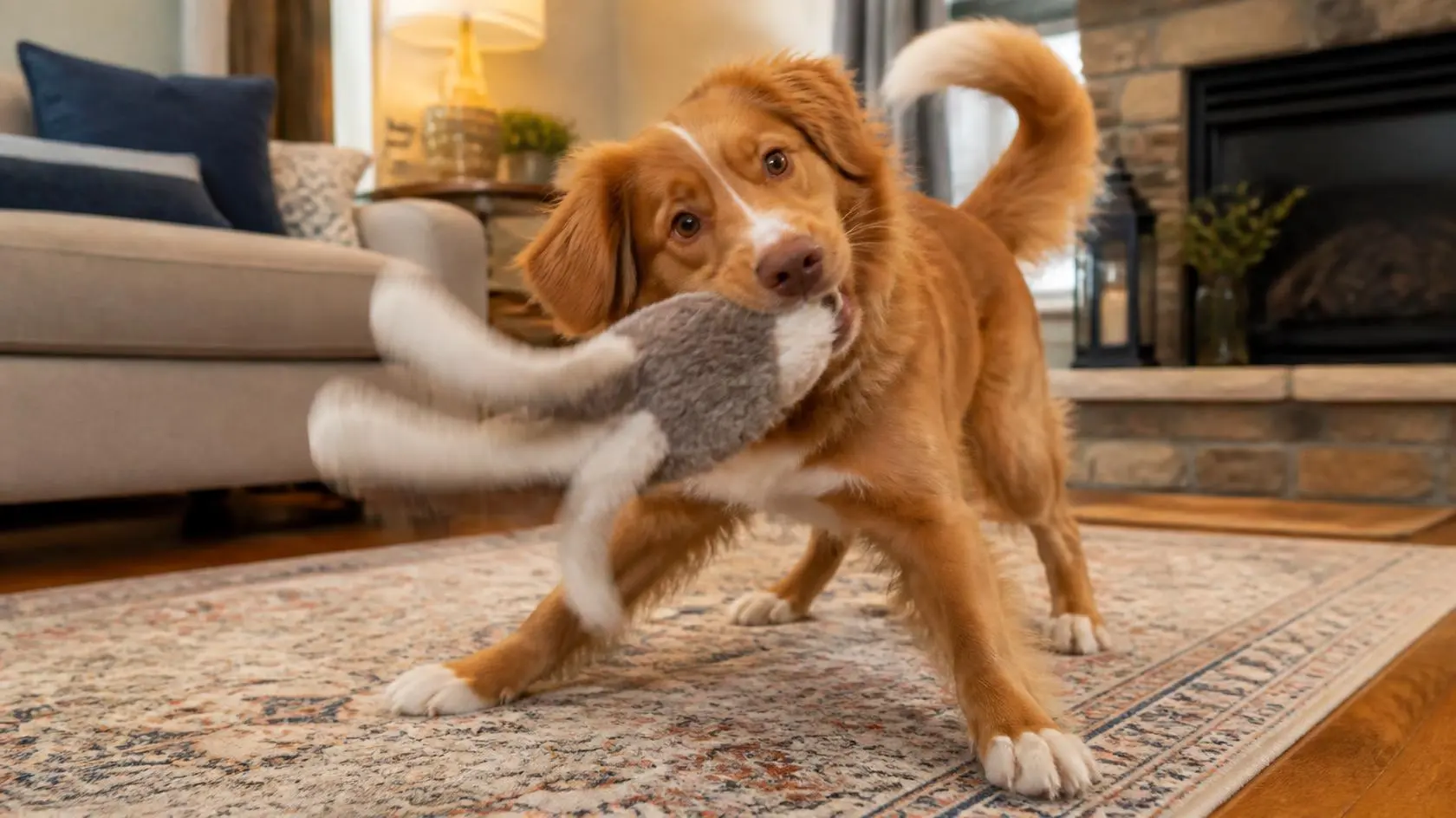
If you've ever watched your dog systematically dismantle a toy in about ninety seconds, then immediately want another one, you've probably wondered what's actually going on in their head. Turns out, most of these toy behaviors have real explanations rooted in instinct — not randomness, and definitely not "spite," whatever the internet says.
Why does my dog destroy their toys?
Destroying toys taps into a deeply rooted predatory instinct — the shaking, tearing, and "disemboweling" motion (especially with stuffed toys) mimics behaviors wild canids use on prey. Squeakers make this extra satisfying because the sound mimics a small animal's distress noise, which is exactly why squeaky toys get destroyed fastest of all. This isn't aggression toward you or a sign of a "bad" dog — it's a normal, deeply instinctive behavior that some dogs express more intensely than others.
Why does my dog nibble or suck on toys instead of chewing?
Gentle nibbling or sucking (rather than full destructive chewing) is often self-soothing behavior, similar to how some dogs suck on blankets or their own paws. It shows up more in dogs weaned early, anxious dogs, or just as an individual comfort habit — not usually something to worry about unless it becomes obsessive or interferes with normal behavior, in which case it's worth mentioning to your vet.
Why does my dog bury their toys?
Burying is an old instinct — wild canids bury food and valued items to protect them from other animals and save them for later. Your dog doesn't need to hide a toy from rival wolves in your living room, but the instinct doesn't know that. Dogs who do this under couch cushions, blankets, or dirt outside are simply following a very old script.
Why does my dog bring you their toys?
This one's more social than instinctive in the wild-animal sense — bringing you a toy is often a bid for interaction, an invitation to play, or in some dogs, a genuine "gift" behavior tied to bonding. Retriever breeds especially are bred for exactly this kind of behavior, so it can be particularly strong in them.
Why does my dog shake or roll on their toys?
Shaking a toy violently mimics the "kill shake" predatory behavior used on prey in the wild — again, totally normal and not a sign of aggression toward you or other pets. Rolling on toys is less understood but often tied to scent-marking behavior — your dog may be transferring their scent onto a valued object, similar to why some dogs roll in interesting (and often unpleasant) smells outside.
Why does my dog like squeaky toys so much?
The high-pitched sound taps directly into prey-drive instinct, mimicking the sound of a small animal — which is exactly why squeaky toys tend to get the most enthusiastic, and often most destructive, reactions. Some dogs seem almost singularly focused on "finding and silencing" the squeaker, which is the instinct working exactly as evolution intended, even if it's inconvenient for your wallet.
Is any of this something to worry about?
Most of these behaviors are completely normal. Signs that suggest it's worth a closer look (rather than "just dog being a dog"):
- Obsessive licking or sucking that seems to increase with stress or can't easily be redirected
- Destructive behavior that's new, sudden, and paired with other anxiety signs (we cover this in more depth in our separation anxiety guide)
- Swallowing pieces of destroyed toys, which is a safety issue regardless of the underlying behavior
What this means for picking toys
If your dog is a serious destroyer, standard toys are going to be a short-term investment — it's worth looking at genuinely durable options built for that specific behavior, which we cover in our guide to chew toys for aggressive chewers. And if a lot of this destructive energy seems tied to boredom rather than pure instinct, redirecting it toward mental stimulation can help — see our enrichment toy guide for options built specifically for that.