Why Does My Dog Lick Me? What Your Dog Is Trying to Tell You
If your dog has ever enthusiastically licked your face, hands, arms, or feet, you've probably wondered whether they're trying to tell you something.
Sometimes the answer is simply that your dog likes you. Other times, there's a much less sentimental explanation: your skin tastes salty, you have food on your hands, or your dog has learned that licking gets an immediate reaction from you.
Licking is a normal part of dog behavior, and it has several possible functions. Dogs lick each other as part of social interaction, puppies lick around their mother's mouth, and many dogs carry licking behaviors into their relationships with humans.
But context matters. An occasional affectionate lick is very different from a dog that spends long periods compulsively licking you, themselves, objects, or the air.
So why does your dog lick you? Here are the most common explanations, what different licking patterns can mean, and when excessive licking deserves a closer look.
Why Do Dogs Lick People?
There isn't one universal reason dogs lick humans. In fact, the same dog may lick you for completely different reasons at different times of the day.
The easiest way to understand it is to look at what is happening immediately before and after the licking.
| When Your Dog Licks You | Possible Reason | What to Look For |
|---|---|---|
| When you come home | Greeting, excitement, bonding | Wagging tail, jumping, following you |
| When you're sitting quietly | Attention, affection, interaction | Dog stays close and watches your reaction |
| After exercise | Salt and moisture on your skin | More interest in sweaty hands, arms, or feet |
| While you're eating | Food smells and learned begging behavior | Focus on hands, mouth, or food |
| During stressful situations | Self-soothing or anxiety-related behavior | Pacing, panting, hiding, trembling, other stress signals |
| When you stop petting them | Attention-seeking | Licking makes you resume interacting |
| Repeatedly and intensely | Habit, anxiety, compulsive behavior, or another underlying issue | Difficulty interrupting the behavior |
1. Your Dog May Simply Be Showing Affection
For many dogs, licking is part of social bonding.
Dogs are highly social animals, and licking appears in several natural canine interactions. Puppies lick around their mother's mouth, and dogs may use licking as part of greeting, social interaction, or affiliative behavior.
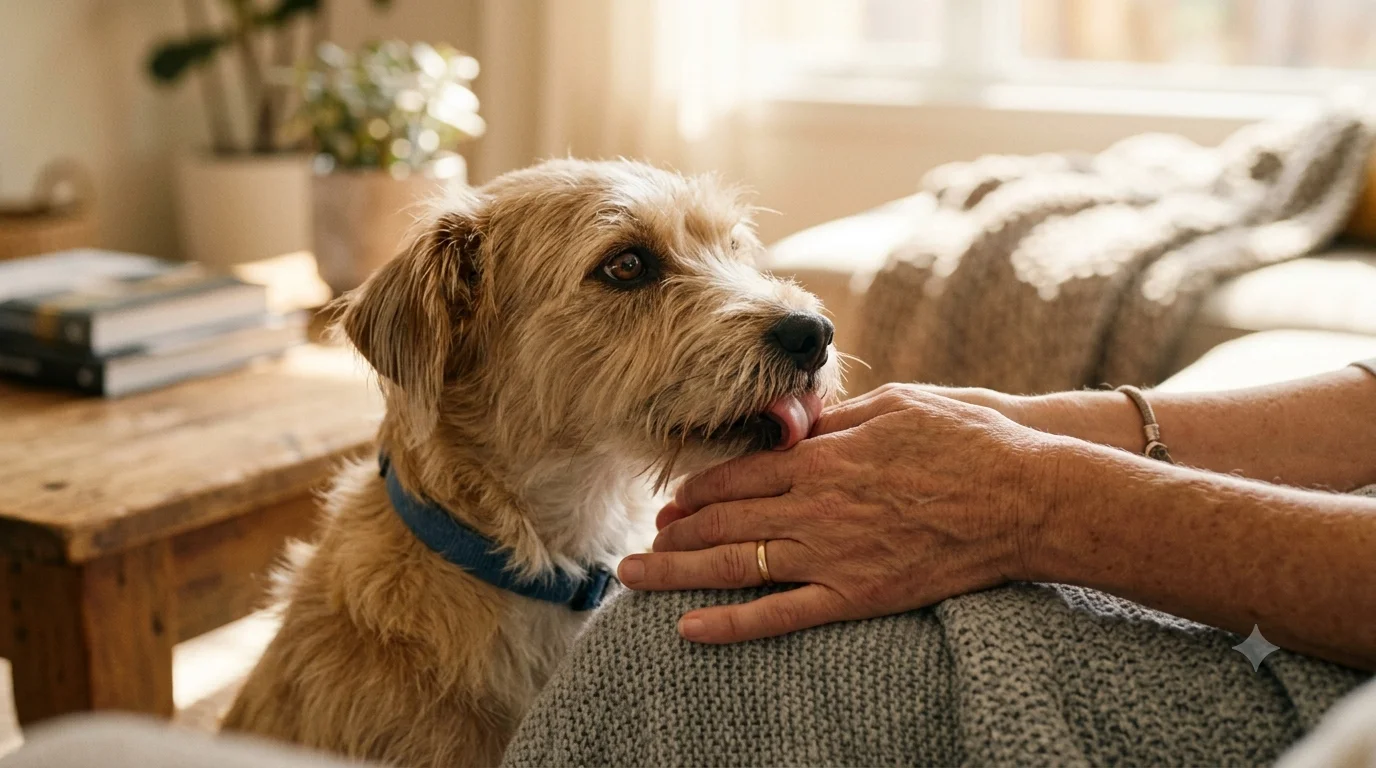
When your dog licks your face after you come home, climbs onto the sofa and gives your hand a few licks, or gently licks you while you're petting them, affection and social interaction are reasonable explanations.
That doesn't necessarily mean your dog is consciously thinking "I am expressing affection right now." Dog behavior is more complicated than translating every action into a human emotion.
But licking can be part of a dog's normal social repertoire, and in the right context it can accompany a relaxed, friendly interaction.
2. Your Skin Tastes Interesting
Sometimes the explanation is considerably less romantic.
Dogs experience the world through their noses and mouths, and human skin can be interesting to them simply because it carries smells and tastes.
Your skin contains naturally occurring salts and other substances, and sweat can make certain areas particularly interesting to a dog.
That's one reason you may notice your dog focusing on your:
- Hands
- Feet
- Arms
- Face
- Legs after exercise
If your dog becomes particularly enthusiastic about licking you after you've been exercising or spending time outside, taste and scent may be part of the explanation.
It doesn't necessarily mean anything is wrong with your dog. Sometimes you simply taste interesting.
3. Your Dog Has Learned That Licking Gets a Reaction
This is one of the easiest explanations to miss.
Dogs learn from consequences. If licking your hand reliably results in you talking to them, laughing, petting them, looking at them, pushing them away, or otherwise interacting with them, your dog may learn that licking works.
Even negative attention can sometimes function as attention from a dog's perspective.
Imagine this pattern:
| Step | What Happens |
|---|---|
| 1 | Your dog licks your hand. |
| 2 | You immediately react. |
| 3 | Your dog learns that licking produces interaction. |
| 4 | Your dog repeats the behavior later. |
Over time, licking can become an extremely effective way for a dog to initiate interaction.
This doesn't mean your dog is being manipulative. They're simply learning which behaviors produce predictable consequences.
4. Your Dog May Be Saying "Pay Attention to Me"
Some dogs discover that a quick lick is an excellent way to interrupt whatever their human is doing.
You're working on your laptop. Your dog walks over and licks your hand.
You stop typing.
You look at them.
You pet them.
From your dog's perspective, the experiment worked.
If licking consistently happens when you're busy, watching television, talking to someone, or looking at your phone, attention-seeking may be part of the pattern.
Look at what happens immediately after the licking. If your response reliably starts an interaction, your dog may simply have learned an efficient communication strategy.
5. Licking Can Be a Greeting
Dogs often use their mouths and noses when greeting people and other dogs.
A dog that approaches you after you've been away and immediately starts licking your hands or face may simply be engaging in an excited greeting ritual.
You may also notice other behaviors at the same time:
- Loose, wiggly body language
- Tail wagging
- Following you around
- Bringing a toy
- Excited vocalizations
- Repeated attempts to get close to you
In this context, licking is just one part of a much larger social interaction.
6. Licking Can Be a Self-Soothing Behavior
Not every licking behavior is about you.
Some dogs lick people when they are uncertain, excited, frustrated, or stressed. Repetitive behaviors can sometimes help a dog regulate their arousal or cope with an uncomfortable situation.
Pay attention to when the licking happens.
| Situation | What to Consider |
|---|---|
| During thunderstorms | Fear or stress may be contributing |
| When visitors arrive | Excitement, uncertainty, or social stress |
| During grooming or veterinary visits | Stress-related licking may occur |
| When left alone | Separation-related distress may be worth considering |
| During unfamiliar situations | Uncertainty or overstimulation may contribute |
If licking appears alongside panting, pacing, trembling, hiding, whining, excessive yawning, lip licking, attempts to escape, or other signs of stress, the behavior deserves to be considered in context rather than dismissed as simple affection.
7. Your Dog May Be Gathering Information
Dogs experience their environment through an extraordinary combination of smell, taste, and other sensory information.
When your dog licks your skin, they're not simply tasting salt. They're also interacting with the collection of scents and chemical signals present on your skin.
Changes in what you have eaten, where you've been, whether you've exercised, and what you've touched can all change the smell and taste of your skin.
Dogs also have highly developed scent-processing abilities, although claims that a dog can reliably diagnose a specific human medical condition simply by licking them should be treated very cautiously.
It's reasonable to say that dogs can detect subtle changes in scent. It is a much bigger leap to claim that every unusual licking behavior means your dog has detected a disease or hormonal change.
8. Why Does My Dog Lick My Face?
Face licking is one of the behaviors owners tend to notice most.
There can be several overlapping reasons:
- Greeting and social interaction
- Attention seeking
- Interest in food or smells around your mouth
- Natural canine licking behavior
- Learned behavior because people respond to it
Some dogs are simply much more enthusiastic about face licking than others.
If you don't mind it, occasional face licking is usually just part of your dog's social behavior. If you don't want your face licked, calmly redirecting your dog to another behavior is generally more useful than repeatedly turning the interaction into a dramatic game of pushing their head away.
9. Why Does My Dog Lick My Hands?
Hands are practically a sensory information center for dogs.
They carry the smells of everything you've touched, along with food residue, sweat, and your normal skin scent.
That makes hands a particularly interesting target.
Hand licking can also become a learned greeting or attention-seeking behavior because humans tend to respond quickly when a dog puts their nose or tongue against a hand.
10. Why Does My Dog Lick My Feet?
Feet can be especially interesting because they tend to accumulate sweat and strong personal scent.
From your dog's perspective, that makes them an information-rich target.
If your dog goes directly for your feet after you've exercised, removed your shoes, or returned home after a long day, smell and taste may explain at least part of the attraction.
If the behavior is occasional and your dog otherwise behaves normally, there isn't necessarily anything concerning about it.
11. Why Does My Dog Lick Me More Than Other People?
Dogs can develop different relationships with different members of a household.
If your dog licks you more than anyone else, several things could explain it:
- You may respond more enthusiastically.
- Your skin may carry smells your dog finds interesting.
- You may spend more time interacting with your dog.
- Your dog may have developed a stronger licking habit with you.
- You may be the person your dog approaches most often for attention.
It doesn't necessarily mean your dog has chosen you as their "favorite human," although the behavior can certainly be part of a close relationship.
12. Why Does My Dog Lick Me When I Pet Them?
This can be particularly confusing because you're already giving your dog attention.
Your dog may respond to petting with licking because the interaction itself is socially stimulating. They may also be communicating that they want the interaction to continue.
Look at the rest of their body language.
| Body Language | What It May Suggest |
|---|---|
| Loose body, relaxed face | Comfortable social interaction |
| Leaning into you | Seeking continued contact |
| Wiggly body and relaxed tail | Excitement or friendly interaction |
| Turning away repeatedly | May be uncomfortable with the interaction |
| Stiff body, pinned ears, tucked tail | Stress or discomfort should be considered |
Never interpret licking in isolation. The rest of the dog's body often tells you much more about how they are feeling.
13. Why Does My Dog Lick Me When I Cry?
Many owners notice that their dogs become more attentive when they are upset.
A dog may approach, stare at you, nudge you, stay unusually close, or lick you when you're crying.
There are several possible explanations. Dogs are sensitive to changes in human behavior, body language, voice, and scent. Your dog may also have learned that crying or distress usually results in a different kind of interaction.
It's tempting to translate this directly into a human concept such as "my dog understands exactly why I'm sad." We can't know precisely what a dog is thinking.
But dogs can clearly respond to changes in human behavior and emotional context, and licking may be part of their response.
14. Why Does My Dog Lick Me After I Shower?
Your scent changes after a shower.
Shampoo, soap, conditioner, water, and other products can temporarily change the smell of your skin. To a dog with a powerful sense of smell, you may suddenly smell like a completely different collection of things.
Your dog may therefore investigate you more closely after you've showered.
Some dogs also seem particularly interested in freshly washed skin because the smell is unfamiliar or simply interesting.
15. Why Does My Dog Lick Me After I Exercise?
Exercise can make your skin saltier and change your scent.
That's one straightforward reason some dogs become much more interested in licking their owners after a workout, run, long walk, or hot day.
If your dog normally ignores your hands but suddenly becomes fascinated by them when you're sweaty, taste and scent are likely contributing to the behavior.
When Does Licking Become Excessive?
There isn't a magic number of licks that separates normal behavior from excessive behavior.
Instead, look at frequency, intensity, context, and whether your dog can disengage from the behavior.
| Pattern | How to Think About It |
|---|---|
| Occasional licking | Usually normal social or grooming behavior |
| Licking during greetings | Often social interaction or excitement |
| Licking after exercise | Taste and scent may be contributing |
| Licking whenever you sit down | Attention-seeking may have become learned |
| Licking during stressful events | Self-soothing or stress-related behavior may be involved |
| Long, repetitive licking that is difficult to interrupt | Worth investigating further |
| Licking accompanied by other unusual repetitive behaviors | Discuss the pattern with a veterinarian or qualified behavior professional |
Signs That Your Dog's Licking May Be Stress-Related
If licking seems connected to anxiety or stress, look for other changes occurring at the same time.
- Pacing
- Restlessness
- Whining
- Excessive panting when the environment isn't hot
- Hiding
- Trembling
- Trying to escape or avoid something
- Repeated yawning or lip licking
- Changes in appetite
- Difficulty settling down
One isolated behavior doesn't prove anxiety. But a collection of stress-related behaviors occurring in the same situation gives you much more useful information.
Should You Stop Your Dog From Licking You?
That depends on your preference and the circumstances.
If your dog occasionally gives you a few affectionate licks and you don't mind, there is generally no behavioral requirement to eliminate the behavior completely.
But if you don't enjoy it, you can teach your dog that there are other ways to interact with you.
The goal isn't necessarily to punish licking. It's to make another behavior more rewarding and predictable.
How to Reduce Excessive Licking
Redirect the behavior
When your dog starts repeatedly licking you, calmly redirect them toward an appropriate activity such as a toy, chew, sniffing game, training exercise, or another behavior they already know.
This gives your dog something to do instead of simply telling them what not to do.
Don't accidentally reward the licking
If attention is the main reason your dog licks you, repeatedly talking, laughing, pushing them away, or petting them can unintentionally reinforce the behavior.
Instead, when practical, wait for a brief moment of calm and then reward the behavior you actually want.
Increase mental stimulation
A dog that doesn't have enough appropriate things to do may develop repetitive behaviors simply because they have become a reliable way to occupy themselves.
Sniffing walks, training sessions, food puzzles, appropriate chew toys, play, and exploration can provide useful mental stimulation.
Look at the trigger
If licking always appears during the same situation, investigate the trigger rather than focusing exclusively on the licking itself.
For example, if your dog only starts licking you when visitors arrive, the underlying issue may be excitement or uncertainty about visitors rather than a general desire to lick people.
Address anxiety rather than only the behavior
If anxiety appears to be driving the licking, simply stopping the licking may not solve the underlying problem.
Reducing the dog's stress and working on the situation that triggers the anxiety is generally more useful than treating licking as the problem by itself.
When Excessive Licking Deserves a Veterinary Check
Licking a person is usually a behavioral question. But if your dog's licking has suddenly changed or become unusually intense, don't automatically assume it's just a habit.
It's worth talking to your veterinarian if the licking is:
- Sudden and substantially different from your dog's normal behavior
- Extremely repetitive or difficult to interrupt
- Accompanied by other unusual behaviors
- Part of a broader pattern of compulsive behavior
- Associated with appetite, sleep, or activity changes
- Occurring alongside signs of pain or illness
Your veterinarian can help rule out medical factors before the behavior is treated as purely behavioral.
Licking You vs Licking Their Own Paws
These two behaviors can look similar but often have very different explanations.
| Behavior | Common Possibilities |
|---|---|
| Licking your face | Social interaction, greeting, attention, taste |
| Licking your hands | Attention, social interaction, sweat, interesting scents |
| Licking your feet | Sweat, scent, attention, learned behavior |
| Licking their own paws | Allergies, irritation, injury, infection, pain, habit |
| Licking their body repeatedly | Itching, allergies, parasites, pain, skin problems, behavior |
If your dog is repeatedly licking their own paws rather than you, that's a separate problem worth investigating. We cover that in our guide to why dogs keep licking their paws.
A Simple Way to Understand Your Dog's Licking
The next time your dog starts licking you, don't immediately ask, "Why does my dog do this?"
Instead, ask five smaller questions:
| Question | What It Tells You |
|---|---|
| When does it happen? | Identifies possible triggers |
| Who does your dog lick? | Shows whether it's person-specific or generalized |
| What happens afterward? | Can reveal whether attention is reinforcing it |
| Can your dog stop? | Helps distinguish casual licking from repetitive behavior |
| What else is happening? | Body language and other symptoms provide context |
That context is much more informative than the licking itself.
The Bottom Line
So, why does your dog lick you?
Sometimes they're greeting you. Sometimes they're seeking attention. Sometimes they like the salty taste of your skin. Sometimes licking is simply part of the way they interact socially with the people they live with.
And occasionally, licking can be a sign that your dog is stressed, overstimulated, bored, or relying on a repetitive behavior to self-soothe.
The key is to look at the pattern rather than a single lick.
A few licks when you walk through the door are very different from a dog that spends long periods compulsively licking you and cannot settle without doing it.
If you don't mind the occasional licking, there may be nothing you need to change. If you do want to reduce it, calmly redirecting your dog, rewarding alternative behaviors, and making sure they receive enough physical and mental stimulation can help.
And if the licking suddenly becomes excessive or appears alongside other changes in your dog's behavior or health, that's when it's worth looking beyond the behavior itself and figuring out what may be driving it.