Why Does My Dog Keep Licking Their Paws? Causes, Signs & What to Do
Most dogs lick their paws occasionally. A little grooming after a walk, cleaning something off their pads after coming inside, or a few licks before settling down for a nap is usually nothing unusual.
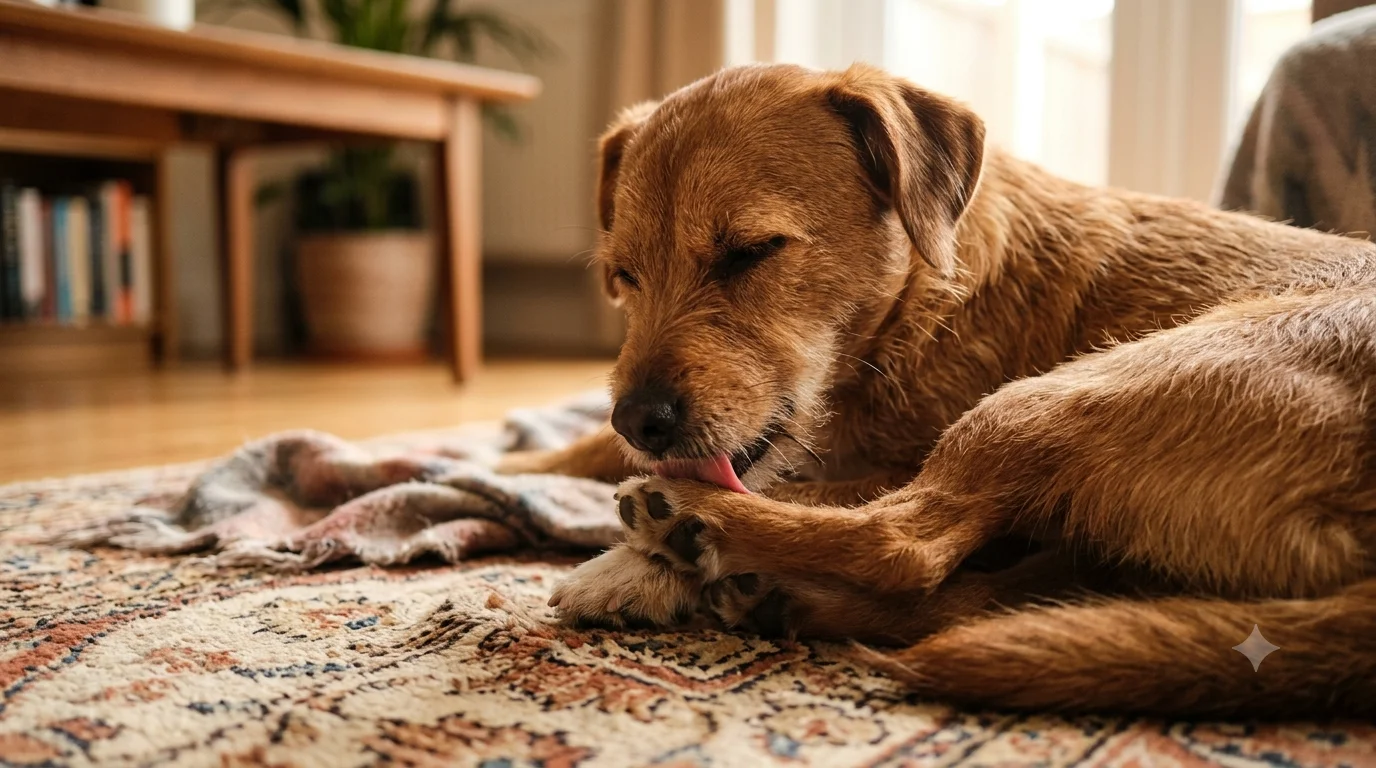
What gets more interesting is when paw licking becomes a repetitive habit. Your dog keeps going back to the same paw, spends several minutes chewing or licking between their toes, wakes up to lick their feet, or seems unable to stop even when you distract them.
Persistent paw licking isn't a diagnosis by itself. It is a symptom, and the reason can range from something simple on the surface of the paw to allergies, parasites, infection, pain, or a behavioral habit that developed after an original irritation.
The location and pattern of the licking can provide useful clues. One dog constantly licking a single front paw raises different questions from a dog licking all four paws after every walk.
Here's how to work out what your dog's paw licking might be telling you, what you can safely check at home, and when it's time to have those paws examined by a veterinarian.
Is It Normal for Dogs to Lick Their Paws?
Yes. Occasional paw licking is part of normal grooming.
Dogs use their mouths to clean their feet, remove small pieces of dirt, and groom areas they can easily reach. You may notice your dog licking their paws:
- After coming back from a walk
- After eating
- After waking from a nap
- Before settling down for sleep
- After getting something on their paws
- Occasionally when simply grooming themselves
The important question isn't "Does my dog ever lick their paws?"
It's "Has the amount, intensity, or frequency of licking changed?"
If your dog has suddenly started spending much more time licking their paws, or the behavior is accompanied by redness, swelling, odor, hair loss, chewing, limping, or visible discomfort, there is probably something worth investigating.
What the Location of the Paw Licking Can Tell You
One of the easiest clues to overlook is which paws your dog is licking.
| Licking Pattern | What It Can Suggest | What to Check |
|---|---|---|
| All four paws | Environmental irritation, allergies, generalized itchiness | Grass, pollen, cleaning products, seasonal changes, redness between toes |
| Several paws, especially between toes | Allergic or inflammatory skin problems are possibilities | Redness, pink/brown staining, odor, swelling |
| One paw repeatedly | Localized irritation, injury, foreign material, or pain | Cuts, thorns, splinters, damaged nails, swelling |
| One toe | Localized injury or irritation | Broken nail, object between toes, sore skin |
| Paws mainly after walks | Something encountered outdoors may be irritating the feet | Grass, chemicals, hot surfaces, rough terrain |
| Paws mostly at night | Itching can become more noticeable when the dog is resting | Skin irritation, allergies, infection, boredom, habit |
This isn't a diagnostic chart. For example, allergies can affect one paw, and an injury can eventually cause a dog to lick several paws because the behavior becomes habitual. But the pattern is a useful starting point.
The Most Common Reasons Dogs Lick Their Paws
1. Something Is Irritating the Paw
Sometimes the explanation is sitting right between the toes.
A tiny piece of plant material, dirt, grit, burr, thorn, or another irritant can make a dog repeatedly lick one particular area. A small irritation may be difficult to spot unless you spread the toes apart and look carefully.
Outdoor surfaces can also irritate paws. Hot pavement, rough surfaces, wet grass, mud, lawn treatments, road salt, and cleaning chemicals around the home can all potentially cause discomfort depending on the dog's environment.
If your dog suddenly starts licking immediately after a walk, think about what their paws came into contact with.
2. Allergies
Allergies are an important cause of persistent itching in dogs, and the paws can become one of the places where that itch is most obvious.
Environmental allergens can include things such as pollen, mold, and dust mites. Some dogs experience symptoms seasonally, while others can have problems throughout the year.
Food allergies can also cause skin problems, although not every dog with itchy paws has a food allergy. Persistent paw licking should not automatically be treated as proof that a particular ingredient is responsible.
Allergy-related paw licking may occur alongside:
- Itchy skin elsewhere on the body
- Repeated scratching
- Ear problems
- Redness between the toes
- Recurring skin infections
- Licking or chewing other parts of the legs
If your dog's paws are repeatedly itchy, especially if the problem keeps returning, a veterinarian can help determine whether allergies are actually involved.
3. Yeast or Bacterial Overgrowth
Persistent licking can create a frustrating cycle.
Itch or irritation → licking → increased moisture → more skin irritation → more licking.
The warm, moist spaces between the toes can be particularly vulnerable to secondary microbial overgrowth.
A musty or corn-chip-like smell can sometimes be noticed around dog paws. This smell is not automatically proof of an infection because normal paw bacteria can also contribute to a distinctive odor. However, a strong or new odor combined with redness, greasy skin, discharge, swelling, or persistent licking is worth having checked.
If your dog has a recurring "Frito feet" smell, you can read our related guide on why dogs' paws can smell like Fritos.
4. Dry or Cracked Paw Pads
Dogs' paw pads are designed to handle a lot, but they aren't indestructible.
Cold, dry weather, very hot surfaces, rough terrain, excessive exposure to water, or certain environmental conditions can contribute to dry or irritated pads.
Look for:
- Visible cracks
- Flaking or rough skin
- Small cuts
- Redness
- Tenderness when walking
- Repeated licking immediately after outdoor activity
Don't assume every dry-looking paw needs a human moisturizer or household cream. Some products can be unsuitable if swallowed, and the appropriate treatment depends on what is actually causing the irritation.
5. A Cut, Thorn, Splinter, or Other Injury
If your dog suddenly becomes obsessed with one paw, inspect it carefully.
A tiny cut or foreign object can be enough to trigger repeated licking. Check the paw pads, the spaces between the toes, and around each nail.
Watch your dog's reaction as well. Pulling the paw away, whining, limping, or resisting examination can indicate that the area is painful.
If something is deeply embedded, you cannot safely remove it, the paw is bleeding significantly, or your dog is clearly painful, veterinary care is appropriate.
6. A Nail or Nail-Bed Problem
Don't forget the nails.
A cracked, split, overgrown, or injured nail can be surprisingly uncomfortable. Dogs may lick one paw repeatedly without making it obvious that the nail is the actual problem.
Check for:
- A cracked nail
- Bleeding around the nail
- Swelling
- Discoloration
- A nail that is caught or growing abnormally
- Sudden sensitivity around one toe
If a nail is badly broken or the nail bed appears injured, don't repeatedly manipulate it just to investigate. A veterinarian can examine it safely and determine whether treatment is needed.
7. Parasites
Fleas and certain mites can cause significant itching. The resulting scratching and licking may involve the paws as well as other parts of the body.
Not seeing a flea does not automatically rule out a parasite problem. Some infestations can be difficult for owners to identify, particularly when the dog is grooming frequently.
If paw licking is accompanied by widespread itching, scratching, hair loss, skin irritation, or recurring skin problems, parasites should be considered along with other possible causes.
8. Pain Somewhere in the Leg
Dogs don't always lick exactly where the original problem is located.
A dog experiencing discomfort in a toe, paw, leg, or joint may focus attention on the area they associate with that discomfort. Older dogs may also develop changes associated with joints that alter how they walk or position their limbs.
This is one reason persistent licking of a single paw shouldn't automatically be treated as a skin problem.
If the licking is accompanied by limping, stiffness, reluctance to climb stairs, difficulty getting up, or a change in the way your dog walks, mention those observations to your veterinarian.
9. Boredom, Stress, or Habit
Once medical causes have been considered, behavior can become part of the picture.
Some dogs lick themselves as a self-soothing behavior. Others may develop repetitive habits when they are bored, under-stimulated, stressed, or experiencing changes in their environment.
There is an important catch, though: behavioral licking should not be the first assumption.
A dog may begin licking because of an itchy paw and continue doing it after the original irritation has improved. That means a behavior that looks psychological can sometimes have started with a physical problem.
Medical causes should therefore be considered before assuming your dog simply needs more exercise or attention.
Why Paw Licking Can Become a Vicious Cycle
One of the reasons persistent paw licking can be difficult to stop is that the licking itself can contribute to further irritation.
| Stage | What Can Happen |
|---|---|
| 1. Initial trigger | Allergy, irritation, injury, parasite, moisture, or another source of discomfort |
| 2. Itching or pain | The dog begins licking or chewing the paw |
| 3. Increased moisture | Repeated licking keeps the skin damp |
| 4. Skin irritation | The skin can become increasingly inflamed or damaged |
| 5. Secondary problems | Microbial overgrowth or additional irritation may develop |
| 6. More licking | The dog responds to the worsening discomfort by licking again |
This is why simply trying to stop the licking without addressing the underlying reason may not solve the problem.
What Does It Mean If My Dog Licks Only One Paw?
One-paw licking deserves a slightly different thought process.
When a dog repeatedly focuses on one foot, look for a local explanation first.
- Small cut or abrasion
- Thorn or plant material
- Something stuck between the toes
- Cracked paw pad
- Broken or painful nail
- Insect bite or sting
- Localized skin irritation
- Pain in the paw, leg, or joint
That doesn't mean allergies are impossible. Dogs with allergies can absolutely have uneven symptoms. But a sudden obsession with one paw is a good reason to inspect that foot carefully rather than assuming it is a generalized allergy problem.
What If My Dog Licks All Four Paws?
When several paws are involved, think about things that affect multiple feet at once.
Environmental irritation and allergic skin disease become more relevant possibilities. Consider whether the behavior changes after walks, during particular seasons, after spending time in grass, or after exposure to a new cleaning product.
Also check whether your dog is itchy elsewhere. Ear scratching, body scratching, belly licking, face rubbing, or recurring skin problems can provide important additional clues.
Why Does My Dog Lick Their Paws After a Walk?
If the behavior consistently starts after going outside, consider what your dog encounters on those walks.
| Outdoor Exposure | What You Might Notice |
|---|---|
| Grass or pollen | Licking after walks, seasonal itchiness, redness between toes |
| Hot pavement | Sudden paw sensitivity, licking, reluctance to walk |
| Rough terrain | Small abrasions, tenderness, focused licking |
| Road salt or de-icing products | Dryness, irritation, increased licking |
| Mud or moisture | Wet skin between toes and increased licking |
| New lawn or surface treatments | Possible irritation depending on exposure |
Think about whether the pattern occurs after every walk or only in a particular location. That information can be surprisingly useful.
What You Can Check at Home
If your dog is comfortable allowing you to examine their feet, a gentle visual inspection can sometimes reveal an obvious reason for the licking.
Check the paw pads
Look for cuts, cracks, bleeding, swelling, or unusual discoloration.
Check between the toes
Separate the toes gently and look for plant material, dirt, redness, swelling, moisture, or irritated skin.
Check the nails
Look for cracks, breaks, bleeding, swelling, or a nail that looks significantly different from the others.
Compare both sides
If your dog is licking one front paw, compare it with the other front paw. Differences in swelling, redness, temperature, or appearance may provide useful clues.
Don't force the examination if your dog is painful, frightened, or likely to bite. A painful paw is better examined by a professional than turned into a stressful struggle at home.
What Not to Do When Your Dog Keeps Licking Their Paws
- Don't assume the cause is definitely allergies.
- Don't automatically start changing foods without discussing persistent symptoms with your veterinarian.
- Don't apply human creams or medications without veterinary guidance.
- Don't aggressively scrub irritated paws.
- Don't ignore persistent licking simply because the skin looks normal at first.
- Don't assume behavioral licking is the cause before physical causes have been considered.
The goal isn't simply to make your dog stop licking. The goal is to understand why they feel the need to lick in the first place.
When Should You See a Vet for Paw Licking?
Occasional licking usually isn't something you need to rush to the clinic for. Persistent or suddenly intense licking is different.
Arrange a veterinary examination if:
- The licking is frequent, intense, or difficult to interrupt.
- Your dog is chewing the paw rather than simply grooming it.
- The skin is red, swollen, raw, or bleeding.
- There is hair loss around the paw.
- You notice a persistent or unusually strong odor.
- Your dog is limping.
- Your dog reacts painfully when the paw is touched.
- One paw suddenly becomes the focus of intense attention.
- There is discharge or significant swelling.
- The problem keeps returning.
- Your dog is also scratching, rubbing their ears, or licking other parts of their body.
When Paw Licking Needs More Urgent Attention
Most paw licking isn't an emergency. However, some situations should be dealt with promptly.
- Heavy or persistent bleeding
- A severe or obvious injury
- A deeply embedded foreign object
- Rapidly developing swelling
- Severe pain
- Sudden inability or reluctance to bear weight
- Suspected exposure to a toxic chemical
- A serious bite or sting accompanied by facial swelling, breathing difficulty, collapse, or other signs of a severe reaction
If your dog appears seriously unwell, don't focus on identifying the exact cause from the paw alone. Seek veterinary care.
A Simple Paw-Licking Timeline
If you've just noticed your dog licking their paws more than usual, the timeline can help you work out what changed.
| When You Notice It | What to Think About |
|---|---|
| First episode | Check the paw for obvious dirt, irritation, injury, or a foreign object. |
| After every walk | Consider environmental exposure, grass, heat, rough surfaces, or irritants. |
| Several times a day | Look for redness, odor, itching elsewhere, and other symptoms. |
| Every day for several days | Persistent licking deserves closer investigation and potentially a veterinary examination. |
| Weeks or months | Recurring allergies, chronic skin disease, infection, pain, or behavioral patterns may need professional assessment. |
| Sudden intense licking | Inspect the paw promptly for injury or localized irritation. |
How to Tell If the Problem Is Getting Worse
Take a quick photograph of the paw when you first notice the problem. If the licking continues, you can compare the appearance later.
Watch for changes such as:
- Increasing redness
- Increasing swelling
- Hair disappearing around the affected area
- Cracked or damaged skin
- New odor
- Discharge
- Increasing sensitivity
- Limping
- More frequent licking
These changes can help your veterinarian understand whether the problem is staying stable or progressing.
Could Paw Licking Be Caused by Anxiety?
Yes, but anxiety shouldn't automatically be blamed for unexplained paw licking.
Some dogs develop repetitive licking or chewing as a coping behavior. You might notice it during periods of boredom, when the dog is left alone, after changes in the household, or during stressful situations.
However, a physical problem can create the same behavior. A dog may start licking because their paw itches and eventually continue licking because the behavior has become repetitive.
That is why a veterinary assessment is useful when the behavior is persistent, particularly if you've also noticed skin changes.
What Your Dog's Paw Licking Pattern May Be Telling You
| What You Notice | Possible Direction to Investigate |
|---|---|
| One paw suddenly | Injury, foreign material, nail problem, localized irritation |
| All paws after outdoor activity | Environmental irritation or allergy |
| Paw licking plus itchy ears | Allergic or skin-related causes become more relevant |
| Paw licking plus strong odor | Skin/microbial problems should be considered |
| Paw licking plus limping | Pain or injury needs attention |
| Paw licking with no visible skin changes | Early irritation, pain, allergy, or behavioral causes are all possible |
| Licking mainly when bored or alone | Behavioral contribution may be worth investigating after medical causes are considered |
Frequently Asked Questions
Why does my dog keep licking their paws?
Persistent paw licking can be caused by allergies, environmental irritation, parasites, dry or damaged paw pads, infections, injuries, nail problems, pain, or behavioral habits. The pattern of licking and other symptoms can help narrow down the possibilities.
Is it normal for dogs to lick their paws?
Occasional paw licking is normal grooming behavior. Frequent, intense, or difficult-to-stop licking is different and may indicate itching, irritation, pain, or another problem.
Why does my dog lick only one paw?
One-paw licking can point toward a localized problem such as a cut, thorn, foreign material, damaged nail, irritated skin, or pain. Allergies can also affect individual paws, so the pattern isn't diagnostic by itself.
Why does my dog lick all four paws?
Licking several paws can occur with environmental allergies, skin irritation, or other generalized itching. If it happens repeatedly, especially alongside ear scratching, body itching, redness, or recurring skin problems, a veterinary examination can help identify the underlying cause.
Why does my dog lick their paws after walking?
Outdoor exposure may be contributing. Grass, pollen, hot pavement, rough surfaces, mud, moisture, road salt, or other environmental substances can irritate paws. If the behavior consistently begins after walks, note where your dog has been walking and whether the pattern changes in different environments.
Does paw licking mean my dog has allergies?
Not necessarily. Allergies are one possible cause, but paw licking can also result from injury, irritation, parasites, infection, pain, dry skin, or behavioral factors. A diagnosis requires looking at the entire pattern rather than using paw licking alone as proof of an allergy.
Why do my dog's paws smell like Fritos?
A mild corn-chip-like smell can occur because of the normal microorganisms living on dog paws. A strong or newly developed odor accompanied by redness, irritation, moisture, or persistent licking can indicate a skin problem that deserves veterinary attention.
Should I stop my dog from licking their paws?
Stopping the behavior without addressing the cause usually isn't enough. If the paw is itchy or painful, your dog has a reason for licking. The more useful approach is to identify and address the underlying problem with veterinary guidance when necessary.
Can anxiety cause paw licking?
Yes, some dogs develop repetitive licking as a self-soothing behavior. However, medical causes should be considered first, particularly when the behavior is new, intense, or accompanied by skin changes.
When should I take my dog to the vet for paw licking?
See your veterinarian if licking is persistent or intense, the paw is red or swollen, there is an unusual odor or discharge, your dog is limping, the area is painful, the skin is becoming damaged, or the problem keeps returning. Sudden severe pain, significant injury, heavy bleeding, or rapid swelling requires more urgent attention.
The Bottom Line
A few casual licks of the paws are usually just part of being a dog. The concern begins when licking becomes frequent, intense, repetitive, or difficult to interrupt.
The pattern can provide useful clues. One paw may point you toward a local injury or irritation. Several paws may make environmental exposure or allergies more relevant. A strong odor, redness, swelling, hair loss, or discharge can suggest that the skin itself needs attention.
But paw licking is a symptom, not a diagnosis.
If your dog has suddenly become obsessed with one paw, start by calmly checking the pads, toes, and nails for anything obvious. If the licking persists, becomes intense, or is accompanied by pain, limping, redness, swelling, odor, or skin damage, it's time to get your veterinarian involved.
And remember the most useful question isn't simply "How do I stop my dog from licking their paws?"
It's "Why does my dog feel the need to lick them in the first place?"